Why Cocaine Has Overtaken Cannabis in Irish Roadside Drug Tests
Cocaine drug driving Ireland; roadside cocaine test Ireland; DrugWipe 6S cocaine; MBRS cocaine statistics; cocaine and cannabis driving Ireland

What the MBRS figures really show, why cocaine use is rising and what it means for Irish drivers
By Patrick Horan, solicitor and former member of An Garda Siochana
Data and official material reviewed: 29 August 2026
If you have tested positive for cocaine at the roadside
A positive DrugWipe result does not mean that you have been convicted of drug driving.
The roadside test is a preliminary screening test.
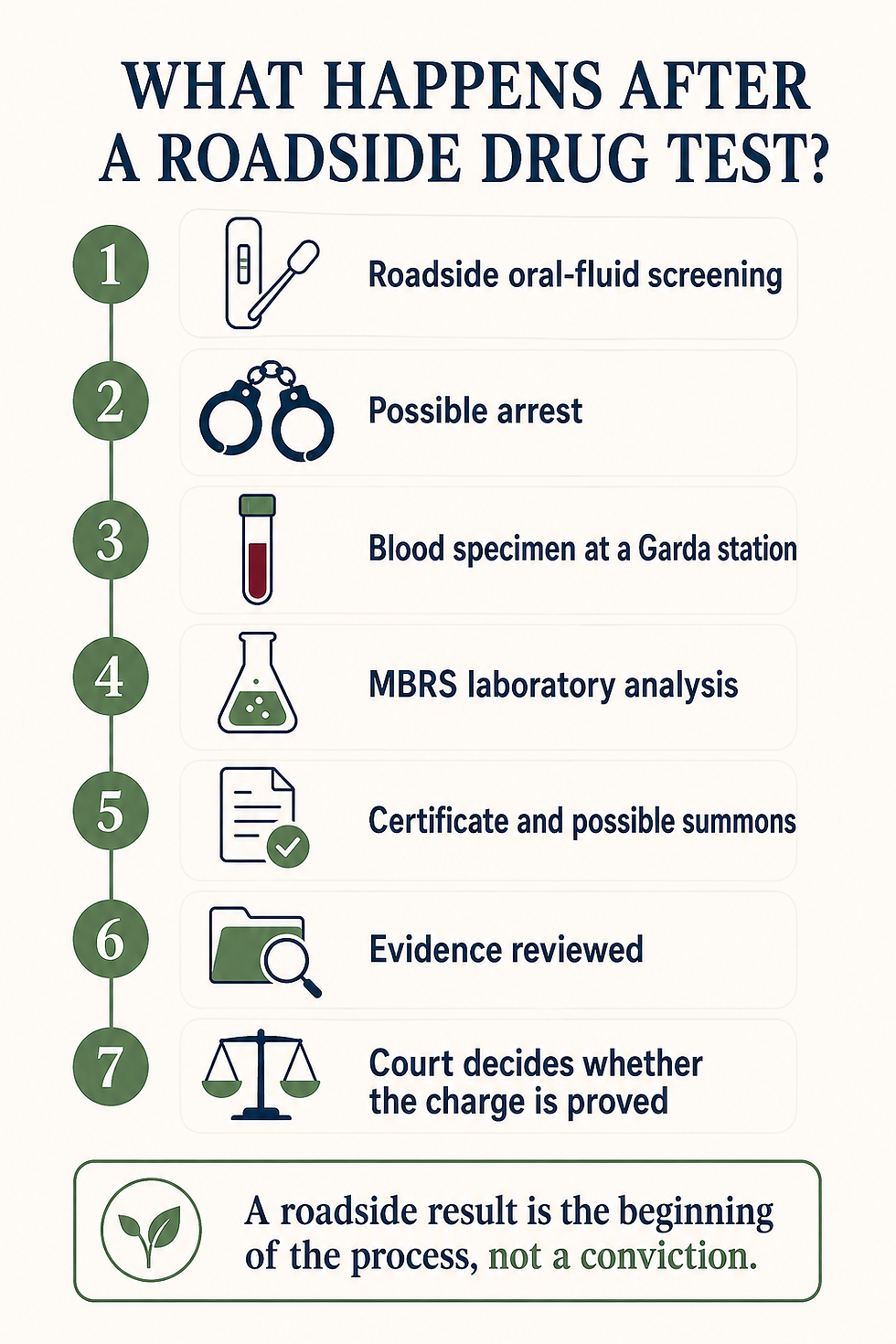
The evidential process normally involves arrest, the taking of a statutory blood specimen and analysis by the Medical Bureau of Road Safety.
The precise position depends on the alleged offence, the MBRS result and whether the required legal procedure was followed.
Keep every document you received.
Write down what happened while it is fresh in your mind.
Do not assume that the roadside result has already decided the case.
Because it hasn’t. being arrested for something is not the same as being convicted.
They are two very different things.
This article explains what a positive cocaine roadside test means. It also examines the much larger question behind it: why is cocaine now appearing so frequently on Irish roads?
______________
The person stopped at the roadside may not look like anybody's idea of a drug driver. Frequently they don’t.
He may be driving to work on Monday morning. She may be bringing the children to school. The cocaine may have been taken at a wedding, in a pub or at a house party two nights earlier.
They feel normal. They are not weaving across the road. They may have been stopped for something as ordinary as speeding.
Usually that’s exactly how they end up being tested.
But cocaine has changed in Ireland.
It is stronger, easier to obtain and no longer confined to nightclubs or a small group of habitual drug users.
That change is now showing up on Irish roads, and in a massive way.
In reported positive Irish roadside drug tests, cocaine rose from 43% in 2019 to 58% in 2025.
Cannabis fell from 66% to 55%.
Cocaine first moved ahead in 2023.
That move towards cocaine is significant, but it must be read alongside the introduction of the DrugWipe 6S at the end of 2022 and the separate MBRS laboratory figures, where cannabis remains the most prevalent drug.
Cocaine has overtaken cannabis at the roadside
The six-year movement in the MBRS annual reports shows the prevalence of cocaine.
Year | Cannabis | Cocaine |
2019 | 66% | 43% |
2020 | 67% | 46% |
2021 | 69% | 45% |
2022 | 66% | 48% |
2023 | 53% | 58% |
2024 | 54% | 59% |
2025 | 55% | 58% |
Source: MBRS annual reports, reported percentages within positive roadside tests. A test may indicate more than one drug, so percentages need not total 100%.
The big change occurred in 2023.
Cannabis dropped by 13 percentage points while cocaine increased by 10 points. Cocaine remained ahead in 2024 and 2025.
The absolute number of positive information forms returned to the MBRS also increased. In 2019, 1,423 forms recorded at least one positive preliminary drug result. In 2025, the number was 2,539. That is an increase of approximately 78%.
What is an “Information Form”?
The Medical Bureau of Road Safety say that “when an oral fluid (saliva) sample is collected from a driver for testing, and it is positive for a drug or drugs, the Bureau requests that An Garda Siochana submit an “Information Form” indicating the result of the test”.
This form lists the driver’s name, whether a roadside drug test was carried out and which of the 6 drugs it screens for (i.e. cannabis, cocaine, benzodiazepine, opiates, amphetamines, methamphetamines) showed up.
In 2025 the Bureau received 2,539 forms from the Gardai. Each of these forms indicated the presence of at least one of the drugs that the DrugWipe tests for.
That comparison still needs care.
The testing system changed, the number of devices or cassettes available changed and the return of an information form depends on Garda reporting.
It is evidence of a much larger enforcement footprint, not a count of every drug-driving incident in Ireland.
On its face, that looks like a sudden change in what Irish drivers were taking. The truth is more nuanced.
Did cocaine really overtake cannabis in 2023?
No. It overtook cannabis in the reported positive roadside results. That is not the same as proving that cocaine became more common than cannabis among every Irish driver or across Irish society.
The timing is important.
The Securetec DrugWipe 6S was introduced nationally in December 2022.
The apparent crossover therefore coincided with a change in roadside screening technology and may also have been affected by Garda deployment, the number of tests used, the motorists selected for testing and the operating characteristics of the device.
The people tested at the roadside are not a random sample of Irish motorists. These figures cannot be converted into a national prevalence survey.
That doesn’t mean we should ignore the trend.
It means we must describe it accurately.
What can safely be said?
The MBRS reports show a major change in what Ireland's roadside screening programme is indicating.
The longer-term rise in cocaine is also supported by population surveys, treatment demand, hospital data, purity evidence, seizures and wastewater analysis.
The roadside pattern is therefore part of a real national change, even if the precise 2023 crossover cannot be attributed to behaviour alone.

The laboratory figures tell a different story
In the MBRS laboratory toxicology figures for 2025, cannabis remained the most prevalent drug and cocaine was second.
There is no contradiction. Roadside screening and laboratory analysis measure different things at different stages.
The DrugWipe 6S uses oral fluid and screens for particular drug groups at the roadside.
The MBRS analyses blood or urine using much wider laboratory methods.
A roadside indication may be followed by arrest and an evidential specimen, but it is not the final blood result.
A person can indicate more than one drug, so prevalence percentages overlap.
Device usage, testing practice and the population tested influence the roadside totals.
In plain English, the roadside test starts the evidential journey. It does not finish it.
This is part of a much larger cocaine increase
The roadside figures become more persuasive when they are placed beside Ireland's public-health evidence.
Last-year cocaine use among adults aged 15 to 64 increased from 1.1% in 2002/03 to 2.4% in 2022/23.
Cases in which cocaine was the main problem drug increased from approximately 1,500 in 2017 to 6,535 in 2025, a rise of about 336%.
Cocaine was the main problem drug in 51% of new treatment cases in 2025.
Cases involving women increased from 284 in 2017 to 1,912 in 2025.
This is an enormous 573% increase in 8 years, showing how “socially acceptable” the use of cocaine appears to have become.
Cocaine-related hospital discharges increased from 1.4 per 100,000 people in 2000 to 24.3 in 2023.
Treatment figures do not measure national consumption perfectly.
They can be affected by service capacity, repeat treatment and willingness to seek help. Roadside figures are also affected by testing practice.
But when several independent indicators move in the same direction, the conclusion becomes difficult to dismiss.
Ireland has experienced a large and sustained increase in cocaine use and cocaine-related harm.
Why is cocaine use rising so rapidly in Ireland?
No single explanation is enough.
The strongest evidence points to a supply-led expansion reinforced by easier purchasing and social normalisation.
In other words, there is more of it around and it’s more socially acceptable to take it, however misguided.
1. Record international supply
South American cocaine production has reached record levels. Larger quantities are entering Europe through commercial ports, freight, maritime routes and smaller vessels. Ireland is connected to that European market.
The Financial Times has reported that the main entry ports for South American cocaine in Europe have traditionally been Antwerp and Genoa.
On 27 October 2025 the Financial Times reported that Belgium was now regarded as a “narco state” by some members of its own judiciary.
Quoting an investigating judge, now living in a safe house for 4 months, Belgium was “facing an organised threat that undermines our institutions”.
The incentives for people to get involved in the drugs trade were clear. “Moving a container in the port” according to the FT analysis “could earn as much as €100,000 and moving a bag €50,000 or more”.
Remember, this is a judge living in a safe house in Belgium. Brussels is the capital of Belgium. It is also the capital of the European Union.
This is what is happening to some members of the judiciary in the heart of the EU: they are living in undisclosed locations protected by the security services.
The enormous profits available to organised crime also create a ready market for recruitment.
People experiencing debt, unemployment or financial pressure may be offered substantial sums to move a container, store drugs temporarily or allow a bank account to be used to move criminal money.
The people recruited may seem far removed from organised crime until they are already involved in it.
The seizure of approximately 2.2 tonnes from the MV Matthew off the south west coast of Ireland in September 2023 showed the scale of consignments criminal organisations are prepared to send towards Ireland. Large seizures can disrupt supply. They also reveal the volume now being moved.
This explains an apparent contradiction.
Authorities can seize more cocaine than ever while users continue to describe it as readily available. The amount intercepted may be rising because the total market is much larger.
Source: EUDA cocaine assessment

2. A stronger and relatively more affordable product
Irish forensic reporting found average street-level purity rising from approximately 34.7% in 2016 to 46.5% in 2019.
Earlier reporting in 2016 described average street purity of about 28% in Dublin and 19% outside the capital.
Purity varies greatly between samples, but some trends can be observed. If the nominal price remains broadly stable while purity rises, the customer receives more cocaine for the money. Inflation and income growth can also make a street price cheaper in pure economic terms.
A stronger product brings greater risk.
It may produce a more noticeable initial effect, faster tolerance and more serious cardiovascular or psychological consequences.
3. Cocaine can now be ordered like a takeaway
WhatsApp, Snapchat, Instagram and encrypted messaging have transformed the drugs market. A person no longer needs to enter an obvious drug scene or know a traditional dealer.
A number is passed through a friend. A menu appears on a phone. The product may be delivered to a house, pub, hotel or social event.
Irish and European reporting was describing this as the “Uberisation” of the drugs trade by 2018.
The 2020 Covid pandemic disrupted pub and nightclub use at first, but it also encouraged home delivery, postal supply and dealers switching between digital channels.
Convenience matters especially with cocaine. Its effects are relatively short-lived and a social session may involve repeated use. The distance between wanting another gram and receiving it has become very small.
4. Cocaine has become socially normalised
Irish reporting now places cocaine at weddings, funerals, work functions, GAA celebrations, house parties, pubs and weekends away.
It is repeatedly described among professional people, employed people, older adults and people living in rural communities.
In short, it is everywhere.
In its 2024 annual report, the Medical Bureau of Road Safety included two maps that they termed a “Geographical Distribution of Cannabis” as well as a “Geographical Distribution of Cocaine”.
These were maps indicating, from an analysis of blood samples received for toxicology, where high concentrations of both drugs were strongest.
While the major cities like Dublin, Cork, Limerick, Galway and Kilkenny featured, so too did small and medium-sized towns.
The maps suggested that high cocaine concentrations in road-traffic specimens were not confined to Ireland’s largest cities.
Several smaller towns also appeared prominently.
They do not establish local population consumption rates, because the specimens came from drivers selected through the enforcement process rather than a random sample of residents.
The maps also drew attention to Charleville, Mitchelstown, Tralee, Longford and Letterkenny. Their appearance illustrates that significant cocaine findings in road-traffic specimens were not confined to Ireland’s largest cities.
Many users do not think of themselves as drug users.
They remain at work, pay bills and care for families. Cocaine can therefore retain an inaccurate reputation as manageable, clean or less serious than drugs associated with visible dependence.
That perceived normality removes a powerful informal barrier.
Once cocaine is circulating through a friendship group, workplace or sports network, a new user may encounter it through somebody they trust rather than through a stereotypical drug scene.
5. It fits dangerously well into long drinking sessions
Some people use cocaine because they believe it makes them feel less drunk, gives them energy and allows them to continue drinking.
Feeling more alert does not mean becoming sober.
Cocaine can mask the perceived sedative effects of alcohol and encourage further drinking. When alcohol and cocaine are consumed together, the body also produces cocaethylene. The combination increases cardiovascular strain.
Ireland had an alcohol-centred social culture long before the recent cocaine increase. Alcohol alone therefore cannot explain the change. The crucial development was an abundant and easily delivered cocaine supply attaching itself to occasions where alcohol was already present.
6. The market is now nationwide
Cocaine is no longer a Dublin nightclub story. Irish reporting has documented ready availability across provincial towns, villages and rural areas, including West Cork and other areas mentioned earlier.
That geographical expansion matters for drug driving.
People frequently drive to rural pubs, hotels, weddings, sporting celebrations and house parties where public transport is limited.
Cocaine use can occur in a setting built around the car journey home or the drive the following morning.
What does this mean for drug driving?
More cocaine use creates more opportunities for cocaine to appear in drivers. But the road-safety problem is more specific than that.
The user may feel completely normal
The feeling of intoxication and the later evidential position are not the same thing. A driver may no longer feel the high but may still have cocaine or benzoylecgonine above the statutory blood limit.
Cocaine can create misplaced confidence
A person may feel energetic, focused and capable of driving. That subjective confidence does not establish that the person has proper control of the vehicle or is below a specified limit.
Ordinary traffic stops can become drug investigations
A driver may initially be stopped for speeding, using a phone, lack of NCT disc or another road-traffic matter. Once you break the law, even in a minor way like this, you can be tested for drugs.
At an authorised mandatory intoxicant checkpoint, an individual suspicion that a motorist has taken drugs is not required before preliminary testing.
Anyone can be tested.
I have represented people who took cocaine days earlier, were stopped for an unrelated driving matter, were tested and arrested for drug-driving in minutes.
The morning-after information gap
Drink-driving campaigns have taught generations of motorists to think about alcohol the following morning. Ireland has done far less to explain the morning or days after cocaine use.
There is no responsible universal waiting time that guarantees when an individual will be below the cocaine or benzoylecgonine limit.
Dose, purity, repeated use, alcohol, individual biology and the time between use and specimen collection all matter.
Cocaine and benzoylecgonine: two separate limits
Benzoylecgonine, usually shortened to BZE, is a principal substance produced when the body breaks down cocaine.
The distinction is important because the original cocaine and its metabolite have separate statutory limits. It is a banned substance among drivers and it can only be in your system due to cocaine use.
Drug or metabolite | Blood limit |
Cocaine | 10 ng/ml |
Benzoylecgonine | 50 ng/ml |
Source: Road Traffic Act 2016, section 8 and Schedule 2.
One nanogram is one billionth of a gram. These limits are extremely small.
In 2025, the MBRS reported a mean analytical cocaine concentration of 115.6 ng/ml among the relevant positive specimens.
That is more than eleven times the legal cocaine limit.
It also reported a mean benzoylecgonine figure of 1028.3 ng/ml.
These are aggregate analytical results, not a timetable for any individual driver.
What does a positive roadside cocaine test prove?
It is a screening indication
A positive DrugWipe indication is not the final MBRS blood result.
It is not a conviction. It provides the basis for arrest and the taking of a later blood specimen in the Garda station.
The usual drug driving arrest journey is:
· Failed roadside oral-fluid screening.
· Arrest and removal to a Garda station.
· A statutory requirement concerning an evidential blood specimen.
· The specimen is sent to the MBRS laboratory.
· Laboratory screening and, where applicable, confirmatory analysis.
· A certificate may issue and Gardaí may apply for a summons.
· The prosecution must prove the alleged offence in court.
The roadside device and the MBRS laboratory are not interchangeable.
The DrugWipe begins the process.
The blood analysis is the evidential result relied upon later.

Does an MBRS result guarantee a conviction?
No. It is important evidence, but it is not the whole prosecution.
The State must prove the legal ingredients of the alleged offence through admissible evidence and the statutory process.
The issues that arise depend entirely on the charge and the facts.
They may concern the legal power used, the arrest, the station procedure, the evidential specimen, the MBRS certificate, service or the evidence actually given in court.
That does not mean every case contains a material error.
Many do not.
It means the evidence and procedure must be examined before anybody assumes that a laboratory result automatically decides the case.
Incorrect claims about Irish drug driving found online
A worried person will often read several solicitor websites before speaking to anyone. Unfortunately, some apparently confident explanations of Irish drug-driving law are wrong or seriously incomplete.
I do not think it helps anybody to repeat those claims without correction.
These are the main ones to watch.
Claim 1: Blood samples are analysed by Forensic Science Ireland
That is incorrect. Evidential blood and urine specimens taken under the road-traffic procedure are analysed by the Medical Bureau of Road Safety. Section 17 of the Road Traffic Act 2010 places the analysis and certification function with the Bureau. The MBRS also states that all laboratory drug testing is carried out at its facility in University College Dublin.
Claim 2: The DrugWipe 6S tests for fentanyl and methadone
It does not. The Irish roadside DrugWipe 6S screens oral fluid for cannabis, cocaine, opiates, benzodiazepines and amphetamines, including amphetamine and methamphetamine. The MBRS laboratory has a much wider analytical scope.
Confusing the roadside device with laboratory testing probably led to this error.
Source: RSA drug-driving guidance
Claim 3: Benzodiazepines, amphetamines and MDMA have specified Irish blood limits
They do not have the specified numerical limits set out in Schedule 2.
The specified substances are THC, THC-COOH, cocaine, benzoylecgonine and 6-acetylmorphine.
Other intoxicants may be relevant to an impairment allegation, but that is a different legal route with different proof.
Claim 4: Any detectable amount of cocaine or cannabis is enough
Not true. Both drugs come with limits attached. This is to prevent the possibility that it was in your system due to innocent mistake e.g. passive inhalation
For a specified-limit prosecution, the State relies on the legal limit of the drug in your blood. For an impairment prosecution, the State must prove the separate ingredients of that offence, including impairment to the required legal standard.
Claim 5: A positive DrugWipe is the prosecution result
It is not. The DrugWipe is a preliminary oral-fluid screening device. The later MBRS analysis of blood or urine is the evidential laboratory result.
A roadside indication may lead to arrest and the specimen procedure, but it is not proof of conviction.
Claim 6: A driver must demand part of the specimen
The legislation says the divided specimen is placed in two sealed containers and a Garda shall offer the person the choice to retain one. If the person keeps one, the other is forwarded. If the person declines, both are forwarded. That is more accurate than saying the driver loses the entitlement unless they know to demand it.
Claim 7: Detection-time tables can tell you when it is legally safe to drive
They cannot. A table may describe an approximate research range for a specimen type and testing threshold. It cannot guarantee when one person will fall below an Irish statutory blood limit. Dose, purity, repeated use, alcohol, biology and the time of specimen collection all matter.

Claim 8: A drug-driving case normally follows exactly three court dates
Some cases do. Others do not. The number of appearances depends on the court, disclosure, plea, contested issues, witness availability and how the list is managed.
A fixed three-date journey creates certainty that the court system does not provide.
Claim 9: Any unexplained period in specimen custody defeats the prosecution
That is no longer a responsible way to describe the law. In DPP v Ratinskis [2026] IESC 33, the Supreme Court restored the conviction and explained the operation of the statutory presumption.
Merely identifying an unexplained period is not necessarily enough. Real evidence capable of displacing the presumption is a different matter.
Why these corrections matter
Drug-driving law involves different testing stages, different offences and different kinds of evidence. Advice should begin with the actual charge, documents and facts, not a generic online promise.
What should someone do after a cocaine-related drug-driving arrest?
Most people want to forget the experience immediately.
Preserve the information instead.
Keep every document supplied at the roadside or Garda station.
· Write down the sequence, times and words used while the memory is fresh.
· Keep any prescription, pharmacy label and relevant medical information.
· Preserve dashcam, journey and location records before they disappear.
· Keep the envelope in which an MBRS certificate or summons arrives.
· Do not publish an account of the incident, alleged drug use or proposed defence online while the case is unresolved.
· Obtain advice based on the actual summons and evidence, not a general internet answer.
What the figures ultimately tell us
Ireland's cocaine increase is best understood as a highly efficient market rather than one sudden change in Irish character.
Record international production has supplied Irish criminal networks with a stronger and relatively more affordable product.
Smartphones and home delivery have made that product exceptionally easy to obtain.
Availability allowed cocaine to attach itself to Ireland's existing drinking and celebration culture. Repeated exposure reduced stigma, and reduced stigma brought new social, geographical and demographic groups into the market.
That creates a self-reinforcing cycle.
More supply creates greater availability. Greater availability creates normalisation. Normalisation attracts more customers. More customers support denser delivery networks. Denser delivery makes the next purchase easier.
Conclusion
Cocaine has overtaken cannabis in reported positive Irish roadside drug tests because a wider transformation in Ireland's cocaine market is reaching the road.
Cocaine has become stronger, easier to obtain, geographically widespread and socially normalised.
Many motorists entering the drug-driving system may feel completely normal and may never have imagined themselves as drug drivers.
How the cocaine market reaches the roadside
In plain English: more cocaine is entering Europe.
It is stronger and easier to buy. It has spread into ordinary social life across Ireland.
That means more people are driving after using it, often after they believe the effects have passed.
Frequently asked questions
Has cocaine overtaken cannabis in every Irish drug-driving dataset?
No. Cocaine is ahead in the reported positive roadside DrugWipe percentages. Cannabis remains the most prevalent drug in the MBRS laboratory toxicology results, followed by cocaine.
Did the change happen suddenly in 2023?
Not really. It had been on the rise over the years. The reported roadside crossover occurred in 2023, but the DrugWipe 6S was introduced in December 2022. The new device and testing practice may explain part of the break. Other Irish evidence independently confirms a substantial longer-term rise in cocaine use and harm.
Can someone test positive after the effects have worn off?
Yes. Feeling normal does not prove that cocaine or benzoylecgonine is below the applicable blood limit.
How long after cocaine is it safe to drive?
There is no universal waiting period that guarantees an individual will be under the legal limit. A person should not use an online detection chart as permission to drive.
Does a positive DrugWipe mean conviction?
No. It is a roadside screening indication. The later evidential process normally involves an MBRS analysis of blood or urine and, if prosecuted, proof of the offence in court.
What are the Irish blood limits?
The specified blood limit is 10 ng/ml for cocaine and 50 ng/ml for benzoylecgonine.
Sources and further reading
_______________________
About Me
I qualified as a solicitor in December 2009 after ten years in An Garda Siochana.
I practises in road-traffic defence, with particular experience in drink-driving, drug-driving and dangerous driving prosecutions throughout Ireland.
This article provides general information and is not advice on an individual case.


Comments