Drug Driving in Ireland: The Definitive Guide for 2026
Updated: Sep 1
What happens from the roadside test to the Garda station, the MBRS laboratory and court?
Drug Driving in Ireland: Definitive 2026 Guide
By Patrick Horan, solicitor and former member of An Garda Siochana. Legal and official material checked: 25 August 2026
This article explains the law generally. Every case depends on its own charge, evidence and circumstances.
You may have taken cannabis on Friday night.
Or cocaine at a party on Saturday.
By Monday morning you feel completely normal. You drive to work, get stopped for speeding and a Garda asks you to provide a specimen of oral fluid (i.e saliva).
The roadside test indicates drugs.
Now you are being arrested for something you did days earlier.
This is the part of Irish drug-driving law that catches people by surprise.
Feeling sober and being under the legal limit are not necessarily the same thing.
But a positive roadside test does not mean you have already been convicted.
In fact, it is usually only the beginning of a much longer process.
This guide explains that process from beginning to end.
The facts, just the facts
Gardaí can require a driver to provide oral fluid in several situations, including at an authorised mandatory intoxicant checkpoint and where the law otherwise allows a preliminary drug test.
Another popular reason to test someone is if they break the law, even marginally.
So if you are stopped speeding or are not wearing your seatbelt you can be tested for drugs even if they don’t believe you are impaired.
I once represented a man who was stopped because he had been too slow to put on his seatbelt as he left a petrol station one morning.
It really can be a case of “any old excuse”.
The Securetec DrugWipe 6S is a roadside screening device.
If it indicates the presence of a prohibited drug, the driver will be arrested and brought to a Garda station.
A blood specimen is then taken and sent to the Medical Bureau of Road Safety, known as the MBRS, for laboratory analysis.
The roadside result is not the final laboratory result.
An arrest is not a conviction.
And even an MBRS result above a specified limit does not remove the State's obligation to prove the prosecution properly in court.
That last distinction matters enormously.
Why drug driving is now such a large issue in Ireland
The latest figures are striking.
According to the MBRS Annual Report for 2025:
6,087 blood and urine specimens were received for alcohol or drug testing;
approximately 4,480 proceeded to drug testing. The report uses 4,477 in its overall programme table and 4,481 in the toxicology section;
3,163 were positive at preliminary laboratory screening for at least one targeted drug class;
that represents 70.6% of the toxicology specimens tested;
drug-positive specimens represented 51.9% of all blood and urine specimens received by the Bureau;
cannabis remained the most prevalent drug, followed by cocaine;
the three most commonly detected drugs were cannabis, cocaine and benzodiazepines; and
30,000 roadside DrugWipe cassettes were supplied to An Garda Síochána during the year. MBRS Annual Report 2025, pp. 4, 5, 12 and 32 to 39
There is another change worth noticing.
In 2019, cocaine was reported in 43% of drug-positive results. By 2025 that had risen to 58%. Cannabis moved in the other direction, from 66% to 55%. MBRS Annual Report 2025, p. 3
Drug driving is no longer a small addition to drink driving.
It is now one of the central parts of Irish roads policing and it’s growing every year.
The first distinction: roadside screening is not laboratory proof
The roadside device is the Securetec DrugWipe 6S.
It uses oral fluid, usually collected from inside the driver's mouth. I think the easiest comparison is a COVID test. It is portable, relatively quick and designed to indicate whether certain drugs may be present.
The MBRS states that the device used in Ireland screens oral fluid for:
cannabis;
cocaine;
opiates;
benzodiazepines; and
amphetamines, including the amphetamine and methamphetamine group. MBRS Annual Report 2025, p. 32
The Bureau describes six drug types because amphetamine and methamphetamine are distinguished within the wider group.
The important word is screens.
A roadside indication provides a basis for arrest and the taking of an evidential specimen.
It is not the same as a laboratory certificate showing what was found in the driver's blood.
In plain English, the roadside device starts the evidential or potential court journey.
It does not necessarily finish it.
When can Gardaí require a roadside drug test?
Many people assume a Garda must first believe that they are high.
That is not correct.
A preliminary oral-fluid (saliva) test may be required at an authorised mandatory intoxicant checkpoint.
Gardaí may also have testing powers where, for example, they form the relevant opinion about intoxicant use, where a driver has committed a road traffic offence, or following a crash. Sections 9 and 10 of the Road Traffic Act 2010, as amended
That means the original reason for the stop may have nothing to do with drugs.
You might be stopped for:
speeding;
using a mobile phone;
failing to indicate;
an NCT, tax or insurance issue;
involvement in a collision; or
some other road traffic offence.
In practice, I have represented people who took cocaine on a Thursday night, were stopped for speeding on Saturday afternoon and then tested positive at the roadside.
They were not weaving across the road.
They were not asleep at the wheel.
The initial reason for the Garda interaction was speeding.
That is how an ordinary traffic stop can become a drug-driving investigation within minutes.
Can Gardaí test every driver at a checkpoint? Drug driving legislation.
At a properly authorised mandatory intoxicant checkpoint, the legislation gives Gardaí powers to require preliminary specimens without needing an individual suspicion that each particular motorist has consumed drugs.
The authority for the checkpoint matters. An inspector or more senior Garda member may authorise it.
The authorisation must be in writing and specify the date, public place and operating hours.
These requirements exist because the power to stop and test motorists without individual suspicion is substantial. Section 10 of the Road Traffic Act 2010, as amended
I have acted in drug-driving cases where prosecutions were withdrawn or dismissed after questions arose about whether the checkpoint had been lawfully authorised for the place where it was actually operated.
That does not mean every checkpoint contains an error.
Most will not. The vast majority will be perfectly legal and correct.
But this is where knowing what to look out for or spot is so important.
It means a criminal prosecution must be examined as evidence, not accepted as a foregone conclusion.
The law insists on legal and procedural safeguards.
It is your lawyer's responsibility to look for those and to see that they have been upheld.
If they haven’t, it can have major implications for the prosecution case.
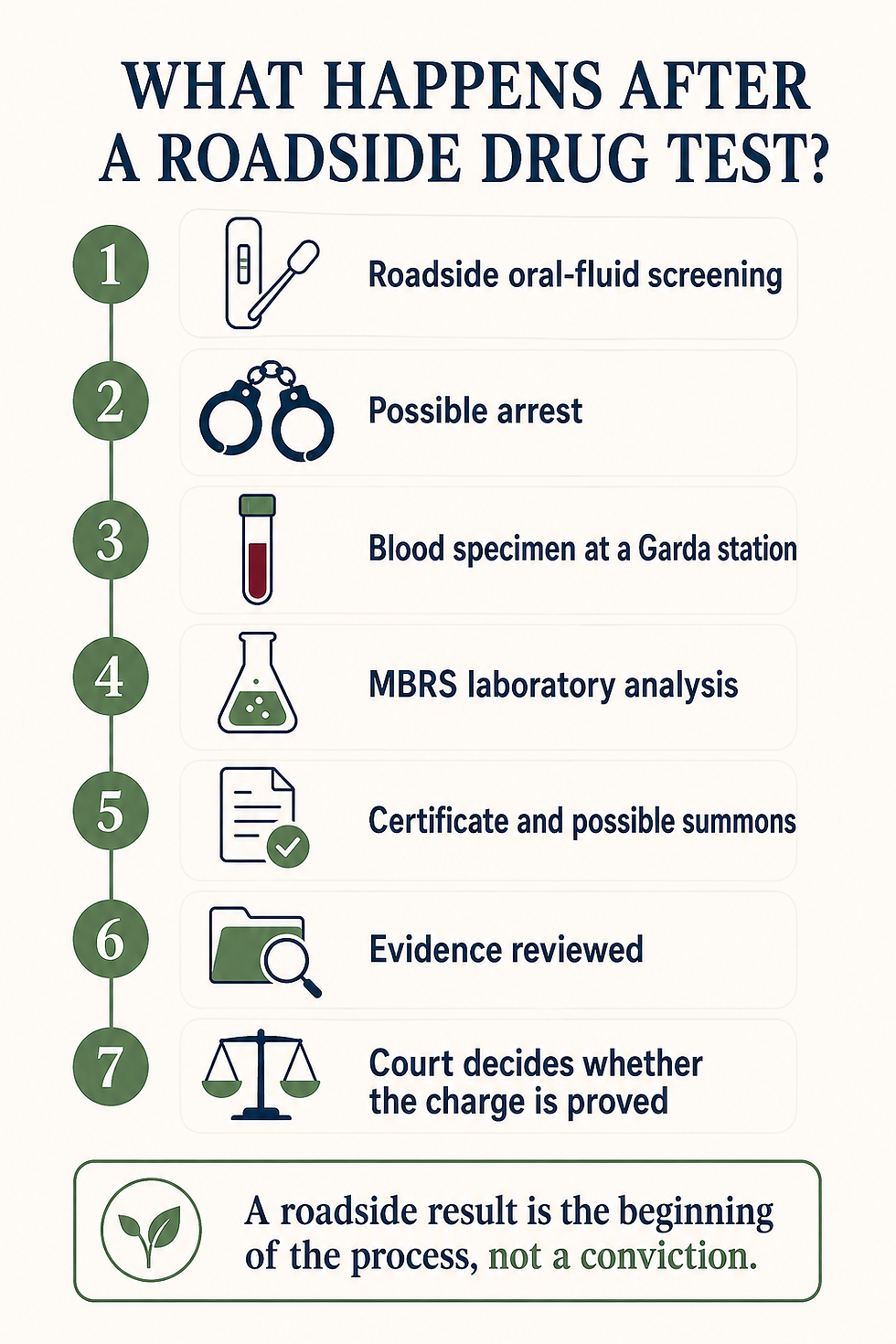
What happens if the DrugWipe indicates drugs?
The usual sequence is:
The DrugWipe produces an indication.
The driver is arrested.
The driver is brought to a Garda station.
A doctor or designated nurse is called.
The driver is required to permit the taking of a blood specimen.
This blood specimen is taken using a syringe of 10ml capacity.
The specimen is divided into two glass vials (5mls each) and you are offered one of these vials to take with you to have independently tested (ref. section 15 Road Traffic Act 2010).
The other vial of blood (or both if you don't take one) is placed in the approved kit and forwarded to the MBRS.
The MBRS screens the specimen in its laboratory.
The blood specimen will be tested for alcohol first. This usually only takes 3-4 days to produce a result. The Bureau then send it for analysis for drugs and this process takes about 9-12 weeks to yield a result.
The reason drug analysis takes so much longer is that testing blood for alcohol takes only a few days, but testing blood for drugs takes weeks.
A specimen that screens positive proceeds to confirmatory analysis, subject to specimen volume.
A certificate of analysis will be issued.
Gardaí decide whether to apply for a summons.
The 2025 MBRS report says 92.3% of specimens analysed for toxicology were blood. Only 7.7% were urine. MBRS Annual Report 2025, p. 35
Blood is therefore overwhelmingly the evidential specimen in modern drug-driving cases.
What does the MBRS laboratory test for?
This is another area where people understandably become confused.
The roadside device and the MBRS laboratory are not limited in the same way.
The DrugWipe screens for the principal roadside drug groups.
The laboratory's 2025 screening method targeted 81 analytes. These included substances and metabolites within the following broad areas:
cannabis and cannabinoids;
cocaine and cocaine metabolites;
opiates and opioids;
benzodiazepines;
amphetamines and methamphetamines;
MDMA and related substances;
methadone;
antihistamines;
antidepressants;
anticonvulsants;
Z-drugs;
ketamine and norketamine;
fentanyl and norfentanyl; and
a number of newer or less familiar psychoactive substances. MBRS Annual Report 2025, pp. 40 to 41
This does not mean that every detected substance creates the same offence or that every drug has a fixed numerical limit.
It means the laboratory has a much wider analytical reach than the roadside cassette.
The second distinction: there are different drug-driving offences
People often talk about “the drug-driving law” as if there is only one charge.
There are different legal routes that the State can take.
Driving while impaired by an intoxicant
One route concerns whether a person was under the influence of an intoxicant to such an extent that they did not have proper control of the vehicle.
The alleged drug may be illegal, prescribed or otherwise lawfully obtained.
The important issue is impairment and the legal proof of the offence.
This is an "observation-type" offence i.e. The proofs here come from the Garda’s own observations of you at the time of your arrest.
Driving over a specified drug limit
A separate route applies to specified drugs with numerical limits in blood.
For this type of allegation, the State does not have to prove impaired driving in the same way.
The concentration of drugs in your blood is central.
The proofs here will be a certificate of analysis from the MBRS showing that you had excess illegal substances in your blood.
The current legal limits are:
Drug or metabolite | Legal concentration in blood |
THC, the principal psychoactive component of cannabis | 1 ng/ml |
THC-COOH, a cannabis metabolite | 5 ng/ml |
Cocaine | 10 ng/ml |
Benzoylecgonine, the principal cocaine metabolite | 50 ng/ml |
6-acetylmorphine, associated with heroin | 5 ng/ml |
These figures are extraordinarily small.
One nanogram is one billionth of a gram.
That is why “I felt completely sober” does not necessarily answer an over-the-limit allegation.
Cannabis: feeling normal does not establish that you are under the limit
This is probably the biggest misunderstanding I encounter.
People assume cannabis works like alcohol.
They consume it, sleep, wake up and feel normal.
They conclude that they are legally safe to drive.
But cannabis does not behave like alcohol in a neat or predictable way.
THC is affected by matters such as:
the amount consumed;
the strength of the product;
how it was taken;
whether the person uses it occasionally or regularly;
metabolism;
body composition; and
the time between consumption and testing.
The MBRS does not give motorists a universal safe waiting period.
That is important.
If the State laboratory does not say that every person will be below the limit after a fixed number of hours, a blog, Reddit post or AI answer should not pretend otherwise.
The 2025 MBRS figures show why the issue is serious.
The mean (roughly “average”) analytical THC concentration reported was 7.5 ng/ml.
The legal THC limit is 1 ng/ml.
The mean THC metabolite concentration was 56.3 ng/ml, compared with a legal limit of 5 ng/ml. MBRS Annual Report 2025, pp. 38 to 39
Those are figures across tested specimens, not a timetable for any individual person.
So how long should somebody wait after cannabis before driving?
There is no honest universal answer.
If there is any realistic possibility that you remain affected or above the legal limit, do not drive.
Cocaine and benzoylecgonine: the high may be gone but the evidence remains
Benzoylecgonine, usually shortened to BZE, is a principal breakdown product of cocaine.
BZE does not exist naturally. You can only have it in your system if you have consumed cocaine.
That's why it's banned.
The distinction matters because a person may no longer feel the effects of cocaine while BZE remains present above its legal limit.
Under Irish law, the blood limit is:
10 ng/ml for cocaine; and
50 ng/ml for benzoylecgonine.
In 2025, the MBRS reported a mean analytical cocaine concentration of 115.6 ng/ml. The legal limit is 10 ng/ml.
That is more than eleven times the legal limit. MBRS Annual Report 2025, p. 39
The MBRS reported a mean cocaine concentration of 115.6 ng/ml. The legal limit is 10 ng/ml.
In plain English, the mathematical average across the reported results was more than eleven times the legal limit.
That does not mean that most motorists recorded that level.
Some results may have been considerably lower and others considerably higher.
The report also records a mean benzoylecgonine concentration of 1,028.3 ng/ml.
The legal limit for benzoylecgonine is 50 ng/ml.
The mathematical average was therefore more than twenty times the legal limit.
These averages do not describe any individual driver. They do, however, show that cocaine and its principal metabolite were being detected at substantial concentrations across the specimens reported by the MBRS.
The larger point remains: cocaine and its metabolite are being found at substantial levels, and cocaine prevalence in drug-positive results has risen sharply since 2019.
What about prescription medication?
Most people hear “drug driving” and think of cannabis or cocaine.
That is too narrow.
Prescription and over-the-counter medicines can matter where they impair driving or where a relevant drug is found through the statutory process.
Benzodiazepines, opioids and some sleep medications are obvious examples, but the answer depends on the substance, the charge and the evidence.
A prescription is important evidence that a drug was lawfully obtained and medically used.
It is not a licence to drive while impaired.
Pay attention to warnings such as:
may cause drowsiness;
do not drive or operate machinery;
avoid alcohol; or
your reactions may be impaired.
Ask the pharmacist a direct question: “Can this medication affect my ability to drive?”
If you have already been stopped, keep the prescription, pharmacy label, dosage directions and relevant medical records.
Do not change your account to make it fit what you later read online.
Is ketamine tested for in Ireland?
Not at the roadside.
The answer changed with the expansion of laboratory testing.
The 2025 MBRS Annual Report lists ketamine and norketamine among the 81 analytes targeted in laboratory screening. MBRS Annual Report 2025, pp. 40 to 41
Ketamine is not listed among the principal drug groups screened by the Irish roadside DrugWipe 6S. That does not mean it is invisible to the MBRS laboratory.
Again, roadside screening and laboratory analysis are different things.
Can you refuse to provide a specimen?
No.
This is disastrous.
Road traffic legislation creates offences for refusing or failing to provide required specimens without a legally recognised basis.
A refusal allegation carries serious consequences of its own i.e. substantial fine 4-year disqualification and potential jail.
The legislation also deals with limited defences involving health and special and substantial reasons. Sections 9 and 22 of the Road Traffic Act 2010, as amended
But a person should never assume that refusing a blood or urine specimen will leave the State without a case and allow them to drive home.
It can create a separate prosecution and if convicted, you’ll face a much higher disqualification period (4 years) than if you had just provided a specimen with even a high concentration of alcohol or drugs.
How long does the MBRS result take?
Drug analysis takes longer (average 9-12 weeks) than the near-immediate result produced by a Garda-station evidential breath machine.
The MBRS reported that drug-analysis reporting times improved during 2025, but it does not promise one fixed turnaround time for every specimen. MBRS Annual Report 2025, p. 4
The practical answer is therefore frustrating but honest: it varies.
You may leave the Garda station without being charged because the evidential drug result is not yet known. A summons can arrive much later.
Silence for several weeks does not mean the matter is over.
Clients have reported to me having received summonses more thana year after their initial arrest.
If you have received a drug analysis from the MBRS (they will send you a copy once the analysis is complete) then it is certain that you will receive a summons from the Gardai at some point.
What should you keep after the Garda station?
Most people want to forget the night immediately.
Do the opposite. Preserve the material while it still exists.
Keep:
every document given to you,
the date, approximate time and precise location of the stop,
the reason the Garda gave for stopping you, if any,
the time of the roadside test,
the time of arrest and arrival at the Garda station,
the name of the Garda station,
details of the doctor or nurse, if known,
any specimen-related form or receipt,
the envelope in which the MBRS certificate or summons arrives,
dashcam footage before it is overwritten,
phone-location or journey records that may later disappear,
a factual account written while your memory is fresh. This last part is by far the most important.
Preserve originals. Do not edit video or alter documents.
Will you receive a charge sheet or a summons?
In an ordinary drug-driving case, the laboratory result is not available before the driver leaves the station.
That is why many drivers leave without a drug-driving charge sheet.
If the later analysis supports a prosecution, Gardaí will apply for a summons.
This is definite, because if they ‘forget’ or fail to do so, they will have to account internally for this lapse and an internal investigation will be initiated.
As this process is quite harrowing you can forget about them ‘forgetting’ about you. They will not.
The Summons
The summons will identify:
the alleged offence;
the legal provision;
the date and location of the offence;
the date of court.
A summons is an allegation.
It is not proof, and it is not a conviction.
Only a court can determine guilt.
What happens in court?
The precise course varies around the country, but a defended road traffic case commonly moves through several stages.
First date
The case appears in the District Court. Representation, disclosure (evidence in the form of Garda statements, documents and CCTV if relevant) and future directions may be dealt with. The matter is then adjourned because these items take time to prepare and serve on your solicitor.
Evidence and advice
The prosecution evidence will be examined, first by your lawyer, but also you.
You need to see what the State is alleging that you did.
After all, you were there, your lawyer wasn’t, and they’ll need to get your version of events.
The disclosure includes Garda statements, checkpoint or stop documentation (‘authorisations’), specimen records, custody records, MBRS certificates and other exhibits.
Plea or hearing decision
After the evidence has been considered, the accused person decides whether to plead guilty or contest the charge.
If a plea of not guilty is entered then a hearing date is fixed by the judge.
Court cases do not always finish on the first or second date.
Disclosure, witness availability and court lists can create delay.
There are usually at least 3 court dates involved.
That is difficult for the accused person.
The case may occupy their thoughts every day even though it is only one file among many for everyone else.
Hearing
If the case is contested, witnesses give evidence and may be cross-examined. The prosecution must prove the offence beyond reasonable doubt.
Does an MBRS result over the limit guarantee conviction?
No.
It is important evidence, but it is not the entire prosecution.
The State must establish the legal ingredients of the offence and prove the evidence through the procedures required by law.
Depending on the charge and circumstances, the case may involve questions concerning:
the legal power to stop or test,
checkpoint authorisation,
the basis and lawfulness of arrest,
the station requirement,
the doctor or nurse and statutory procedure,
identification and continuity of the specimen,
the MBRS certificate, and
the evidence actually given at trial.
This is not a promise that an error exists in every file.
It does not, but you need to check and you need to know what to check.
It is a reminder that “the laboratory found a drug” and “the prosecution has proved every element of the offence” are not identical statements.
Real drug-driving cases I have handled
The untrained operator
In one case at Waterford District Court, a motorist had been involved in a collision and was tested using the older Dräger device.
The test indicated benzodiazepines and opiates.
During cross-examination, the prosecuting sergeant accepted that he had not been trained to operate the device and was not familiar with how it worked.
The arrest had been based on the device result.
The judge had a doubt that a machine operated by an unqualified user had been used correctly. The drug-driving charge was dismissed.
The lesson is not that training will always defeat a prosecution.
The lesson is that the machinery does not give evidence by itself.
A human being uses it, and the court is entitled to examine how.
The checkpoint location
I have also acted in cases where a mandatory checkpoint had been authorised for a specified place, but questions arose about whether it was operated at that authorised location.
Maps, official documentation and the Garda evidence mattered.
In some of these cases the prosecutions were withdrawn.
Again, this is not a generic escape route. It is an example of a broader principle: when the State relies on an exceptional power to test without individual suspicion, the statutory basis for that power matters, and in the case of mandatory checkpoints, will be strictly interpreted and enforced against the State by the court.
What is the penalty for drug driving?
A conviction will carry:
a mandatory driving disqualification of one year for a first offence.
a fine of usually between €200 and €700
the possibility of imprisonment: this is very rare unless an accident had occurred.
a criminal conviction. This is definite if you’re convicted.
increased insurance difficulty or cost: some insurers are refusing to renew if there’s a pending prosecution, even before a person might be convicted.
practical consequences for work, family and daily life.
For a first conviction for a specified-drug over-the-limit offence, the minimum disqualification is one year.
It is at least two years for a second or subsequent conviction, if that second conviction happened within 10 years of thew first conviction.
An impairment conviction under section 4(1) carries a minimum four-year disqualification for a first offence. Section 26 of the Road Traffic Act 1961, as amended
The court cannot simply replace a mandatory disqualification with sympathy because the person needs to drive for work.
That is why the decision about plea or trial should be made after the evidence has been reviewed, not from shame or panic.
The emotional part nobody explains
Most people I represent in drug-driving cases have never been arrested before.
They have jobs. Families. Mortgages. Plans.
They are frightened of losing their licence, but often they are even more frightened of telling a partner, parent or employer.
Drink driving carries stigma. Drug driving can carry a different kind of shame.
People assume the word “drugs” tells them everything about the person.
It does not.
I have represented solicitors, Gardai, doctors and consultants who have been arrested for drink or drug driving.
They were not "bad" people.
Neither are you.
People fear the look on their mother's face more than they fear the judge.
That fear can cause bad decisions.
Some people want to plead guilty immediately just to end the uncertainty.
Others refuse to open letters or convince themselves that no summons will arrive.
Neither reaction helps.
The shame you feel today is not evidence.
It should not decide the case.
Your first job is to find out precisely what the State alleges and what evidence it has.
As I’ve always said to clients who have been acquitted: “good people deserve a break and you got the break today”.
Why my approach is different
I served in An Garda Síochána from 1997 to 2007 before qualifying as a solicitor in December 2009.
I now defend road traffic cases in courts throughout Ireland.
I have seen this process from both sides and in every significant court in the country in front of all judges.
Judges are not all the same.
They don’t all think the same and an argument that might fail on one judge might work with another, simply because that judge gave some piece of evidence more weight than their colleagues did.
That does not allow me to predict every result.
No responsible solicitor should promise that.
But it has allowed me to establish some 'rules' about court advocacy.
I have one iron rule: “don’t tell me the law, tell me who the judge is”.
That is more critical than anyone will ever tell you.
Drug Driving Defence
I approach the file as a sequence:
Why was the vehicle stopped?
What legal power was used to require the roadside specimen?
What did the device indicate?
What was the basis of arrest?
What happened at the Garda station?
How was the evidential specimen obtained and recorded?
What did the MBRS certify?
What charge was selected?
What evidence can actually be proved in court?
The objective is not to find a magic word.
It is to replace uncertainty with a careful understanding of the case.
Frequently asked questions
Can I be prosecuted even though I was not high?
Yes. For a specified-drug over-the-limit allegation, the State does not have to prove impairment in the same way as an impairment prosecution. The actual charge and MBRS result must be examined.
Is the roadside test enough to convict me?
No. The DrugWipe is a preliminary screening device. In the usual positive-roadside-test case, an evidential blood specimen is taken and analysed by the MBRS. The prosecution as a whole must still be proved in court.
Can a Garda drug-test me merely because I was speeding?
Yes. The legislation permits preliminary testing in several circumstances, including certain road traffic offences like speeding, holding a mobile phone etc.
Can I be randomly tested without appearing impaired?
Yes, at a lawfully authorised mandatory intoxicant checkpoint. Individual suspicion is not required in the same way at such a checkpoint.
Does the DrugWipe test for ketamine?
No. The 2025 MBRS report does not list ketamine among the main roadside DrugWipe groups. It does list ketamine and norketamine among the 81 analytes targeted by the laboratory.
Does the MBRS only test for cannabis and cocaine?
No. Cannabis and cocaine are the most prevalent drug groups, but the 2025 laboratory screening list contains 81 analytes across numerous drug classes.
Does a prescription protect me?
Not from driving while impaired. A prescription may be highly relevant to lawful use and medical context, but the precise charge, substance, dosage and evidence matter.
How long after cannabis can I legally drive?
There is no universal safe period that applies to everyone. Cannabis can affect different people differently and can remain detectable after the obvious effects have passed. Do not drive if there is a realistic possibility that you remain impaired or above the limit.
How long will the MBRS result take?
It varies. Usually 9-12 weeks. Drug analysis generally takes longer than alcohol breath testing. The MBRS reported improved turnaround times in 2025 but does not give one guaranteed period for every case.
Will I be charged before leaving the Garda station?
No, because the blood sample that was taken from you has to be analysed by the MBRS first. A summons may follow after the MBRS result is received.
Should I plead guilty because the laboratory result is over the limit?
Not on that fact alone. The result is important, but the charge, Garda evidence and legal procedure should be reviewed before a plea is entered.
Can a judge let me keep my licence because I need it for work?
A judge cannot disregard a mandatory statutory disqualification merely because losing the licence will cause hardship. The same position exists for people who are the carers of elderly relatives or children. If you’re convicted you will be disqualified. So the real issue is not to be convicted.
In plain English
I believe in speaking and writing in plain English. If you look at the other 355 articles on my website, they are all written in this style.
That's because I want to be understood quickly.
A roadside drug indication is the beginning of the process.
It may lead to arrest, a Garda-station blood specimen, MBRS analysis and a summons months later.
Feeling sober does not necessarily mean being under a specified drug limit.
But neither arrest nor an MBRS result amounts, by itself, to a court conviction.
Keep every document.
Preserve recordings before they disappear.
Write down what happened while it is fresh.
This is so very, very important. I say this to all my clients: write down what happened from start to finish. What was the Garda saying to you? What were you saying to them?
If I was quietly standing there when you were arrested what would I see, what would I hear?
Write everything down.
If you do that you’ll give your lawyer the best chance they need to help defend you.
You are not the allegation written on the summons.
And you should not decide your future while frightened or ashamed.
What happens after a roadside drug test?
Roadside oral-fluid screening↓
Possible arrest↓
Blood specimen at Garda station↓
MBRS laboratory screening and confirmation↓
Certificate and possible summons↓
Disclosure reviewed↓
Case fought
Court determines whether the offence is proved


Comments